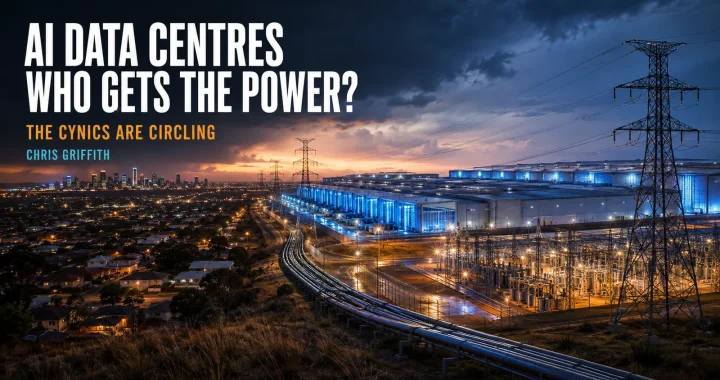
The Australian Government faces a massive challenge to prevent Australia’s electricity supply from being monopolised by AI-ready data centres and potentially leaving the public in the dark.
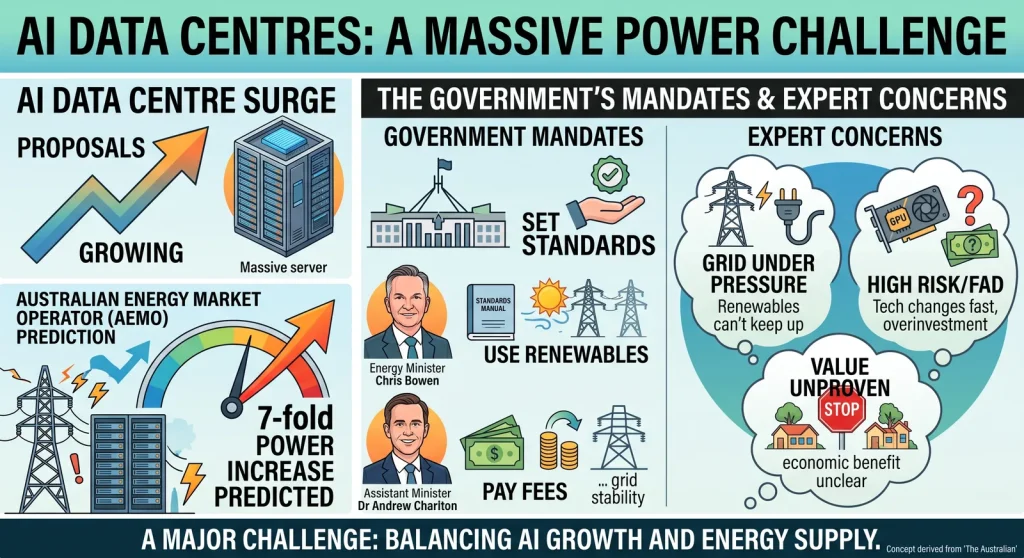
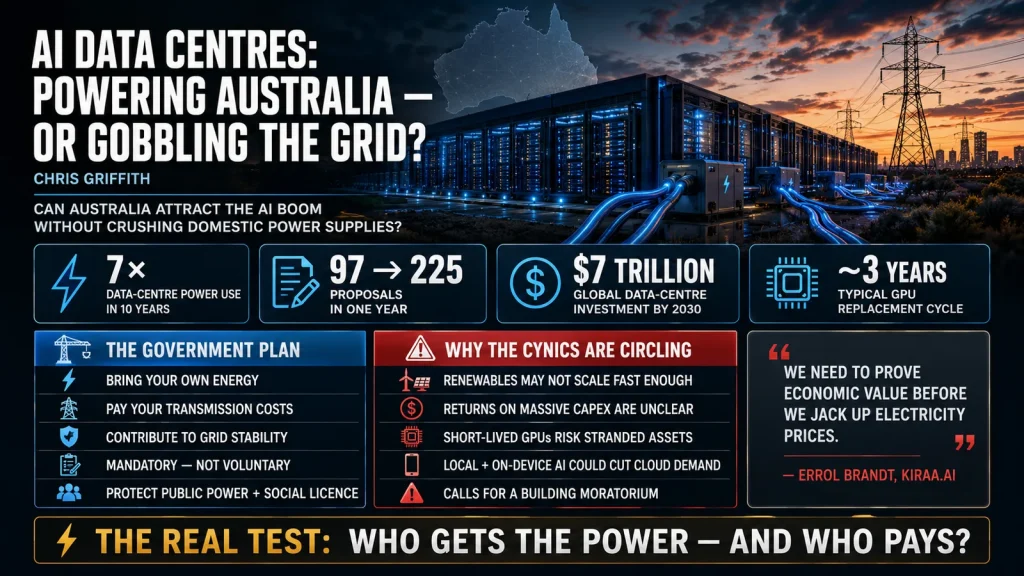
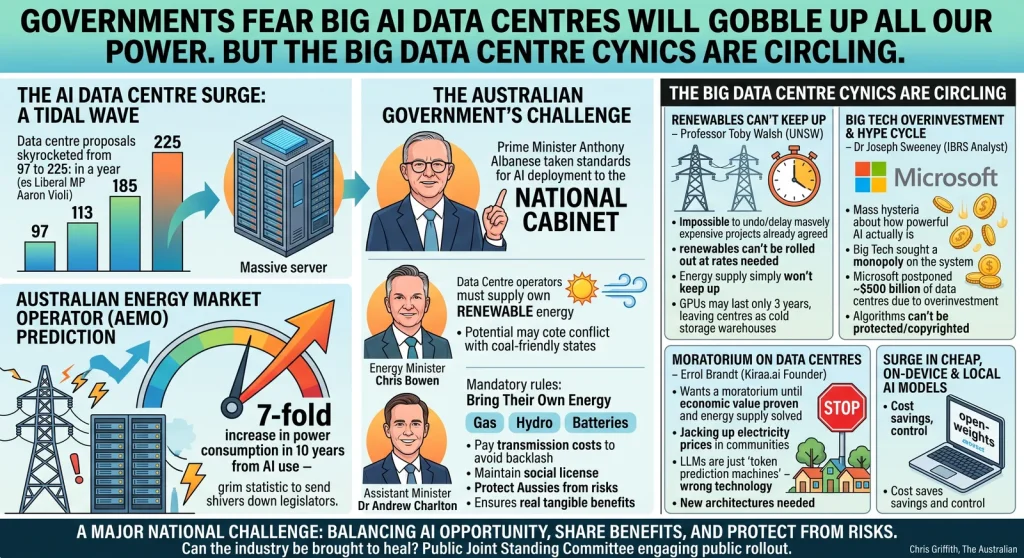
An Australian Energy Market Operator prediction of a seven-fold increase in power consumption in 10 years from AI use is the latest grim statistic to send shivers down the spines of legislators faced with a tidal wave of data centre proposals.
The forecast comes as Prime Minister Anthony Albanese takes a set of standards for AI deployment to the National Cabinet with data centres at the top of the list.
Energy Minister Chris Bowen says data centre operators have to supply their own energy needs from renewable sources. This edict is expected to be vehemently opposed by coal-friendly states such as Queensland.
Small modular reactors and microreactors advocated by some big US tech firms such as Oracle co-founder Larry Ellison have been on the minds of some, but are not regarded as commercially ready technology yet.
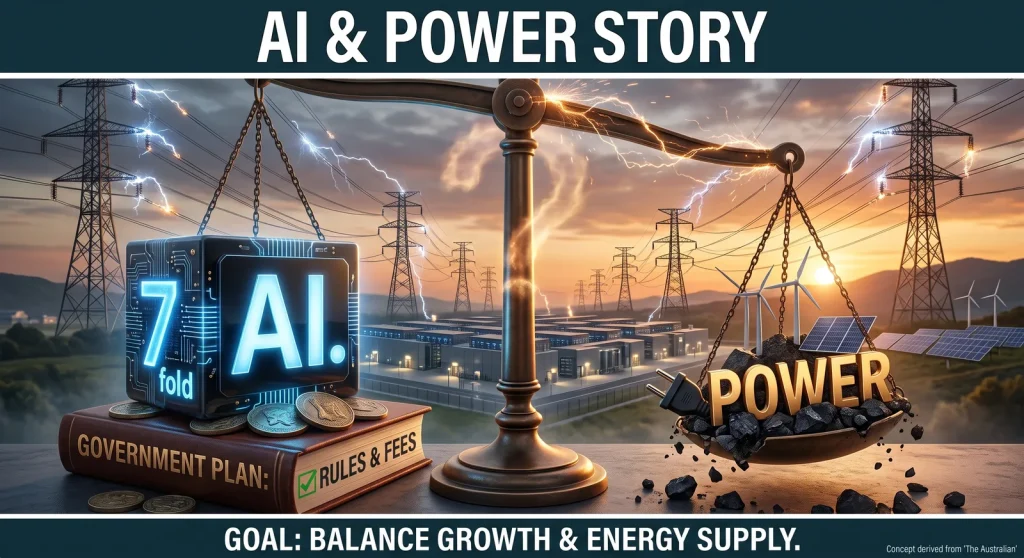
A clash with states over coal is the least of Albanese’s worries. The biggest challenge will be garnering enough power for the AI datacentre juggernaut without it crushing domestic energy supplies.
And the cynics are circling. Successive Australian governments already have trouble getting big tech to pay its share of tax; they thumb their noses at government. Will they also thumb their noses at attempts to constrain data centre rollouts through “standards”? Can some projects be delayed to allow available energy supply to catch up? Can this massive industry be brought to heel?
Speaking at a Tech Leaders’ Conference at Bowral, Toby Walsh, Professor of Artificial Intelligence at University of New South Wales (UNSW) says it would be almost impossible to undo (or delay) many of the massively expensive projects already agreed to and now on the drawing board. So much money is at stake.
Professor Walsh also says that on current trajectories, renewables can’t be rolled out at the rates needed by data centres.The energy supply simply won’t keep up.
According to reports, data centre proposals have skyrocketed from 97 to 225 over the past year, a factor which saw Liberal MP Aaron Violi blast the Albanese government for being behind the eight-ball on implementing AI industry standards and regulations.
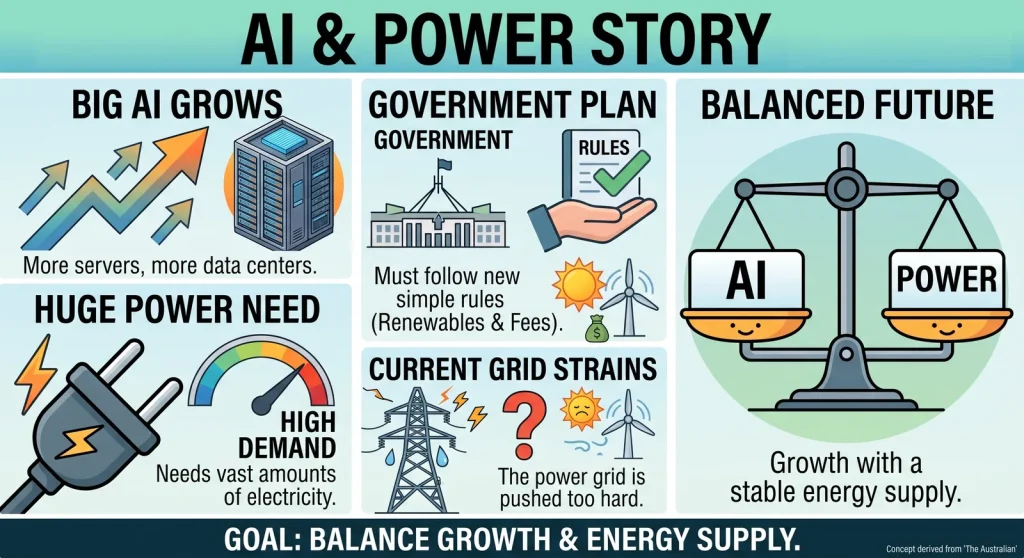
“Businesses, particularly the tech sector, expected a forward-looking roadmap and clear rules of engagement for the years ahead,” Mr Violi told the conference.
“Instead the government announced an office within an office or the Office of AI alongside a new set of regulations for data centres.
“To be clear we absolutely need a plan for data centres to ensure they work for our communities but a set of rules for data centres isn’t a substitute for a national AI plan and frankly it’s concerning that the Prime Minister and the government conflated the two.”
Mr Violi said parliament’s new Joint Standing Committee on AI, established a week ago, would seek to directly engage with the public on the AI rollout.
In his keynote speech, Assistant Minister for Science, Technology and the Digital Economy, Dr Andrew Charlton, said the government had three objectives: to capture the opportunity for Australia with AI, to ensure all Australians share the benefits, and to protect Australians from the risks.
“The Prime Minister is taking those AI standards to National Cabinet this week with a view to legislating them in the not too distant future,” Dr Charlton said.
“The purpose of these standards is to make sure that we attract an outside share of global compute, but do it in a way that maintains social license, avoids the backlash that we’ve seen in other countries and delivers real tangible benefits to Australians.”
He says it is vital that Australians share the benefits of AI deployment “because I feel that if we don’t do this, we will lose social license very quickly … Australians more broadly have pretty low trust in AI.”
He says not only will data centres be required to “bring their own energy”, comprising gas, hydro and batteries, they will also have to pay their own transmission costs and contribute to grid stability.
“These requirements will not be voluntary. They will be mandatory.
“We’re not putting those rules onto these data centres in order to harm the industry, far from it. We are putting these rules onto data centres in order to put the industry on a stable foundation.”
Not everyone sees a future of massive AI-crunching data centres as the way forward.
Professor Walsh says it’s hard to see how investors in data centres will be rewarded with adequate returns.
“The estimate is that there’s going to be something like $7 trillion being invested into data centres around the world before 2030. It’s hard to understand how they’re going to see an adequate return on that investment.”
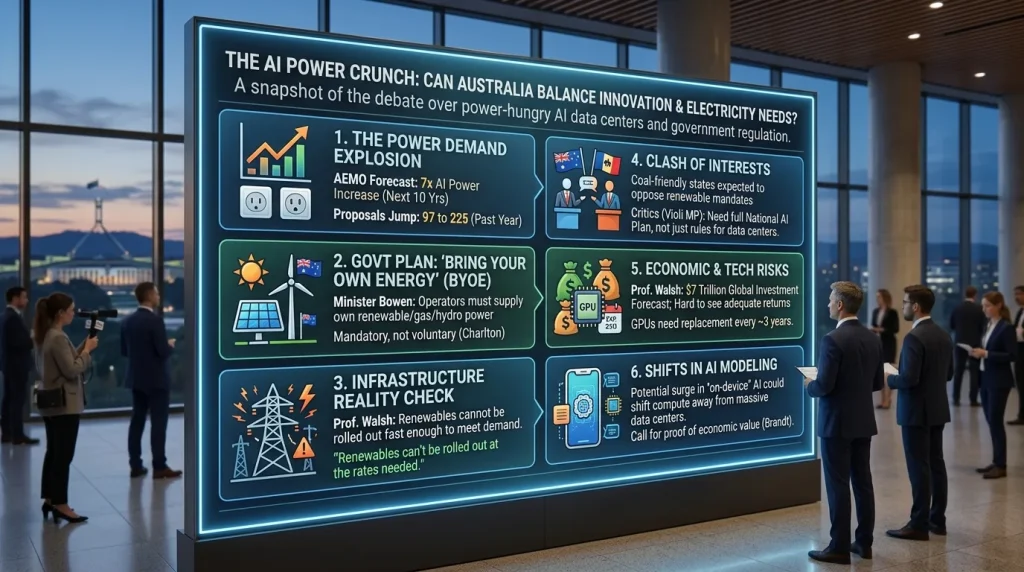
The fact data centres need to be refurbished periodically, and that GPU’s may last only 3 or so years before they are replaced, suggests that after ten or twenty years, they may end up as cold storage warehouses or distribution centres, he says.
Others at the conference spoke of a coming surge in cheap, on-device AI models that would see much big tech AI compute move onto devices.There is also signs of a pushback against large language model AI “hype” and “hysteria” and overinvestment.
IBRS industry analyst Dr Joseph Sweeney says Microsoft and big tech more generally thought they could gain a monopoly through large scale AI deployment.
“They, meaning the big technology organizations out of the US, were thinking that they could do what Microsoft has always done: gain a new monopoly on the system.
“The problem was AI, or generative AI, or large language models, and more specifically vector databases, are an algorithm. You can’t copyright them, you can’t intellectually protect them in any way whatsoever, just like machine learning.
“And so when we saw this, and started writing this about three years ago, this slide, we were saying, yeah, this is going to be a disaster.
“What we are thinking is actually happening, that there has been a mass hysteria about how powerful and what AI actually is from the big tech bros.
“At least early last year, we could see that AI costs were going to skyrocket … they were losing money.
“Microsoft, about two years ago, saw this coming and pivoted. They didn’t stop building their own data centres, but they certainly postponed about $500 billion (worth) of them.
“Why would you do that? You do that because you realize that your overinvestment isn’t going to pay off, or maybe you’re not sure if it’s going to. So you’re hedging your bets. You’re pushing out that financial risk.”
SCX.AI CEO David Keane says that a year ago, everyone was using the proprietary big guys, but this is changing.
“Irrespective of where the information went, irrespective of our privacy and security and governance, we were using them.
“Now with local models that are running on these open weights environments, we can deliver cost savings and a significantly greater amount of control.”
Kiraa.ai founder Errol Brandt wants a moratorium on the building of data centres.
“I believe we need to stop building data centres in this country, we need to prove that the technology that’s already deployed is providing economic value before we start jacking up electricity prices in communities more than they already are, until we can sort out where our energy supply is going to come from. We haven’t worked that out yet.
“Number two, I don’t think that LLMs are the right technology. People are all putting their faith into token prediction machines.
“There are brand new architectures out there, which are much more suitable for reasoning and advanced decision making than simply predicting the next token.
“Number three, I think the whole cloud AI hyperscaler model, six of them, of the magnificent seven, the stupid six, have all gone down this path of capex.”
Published in iTWire, 25 August 2026 AI graphics courtesy of iTWire.