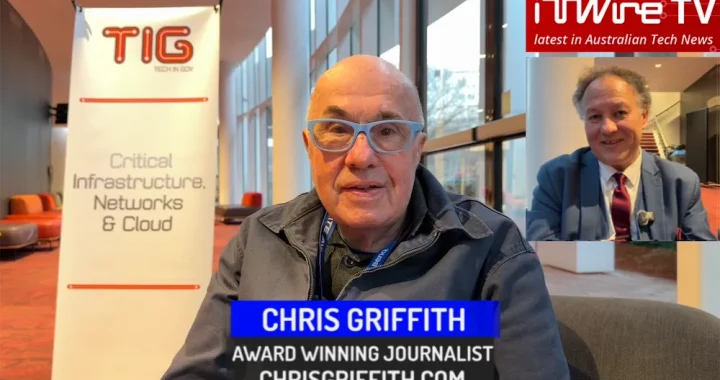
There’s a growing realisation among the Australian bureaucracy that replacing entire processes with AI comes at a cost. Welcome to the world of tokenomics where senior public servants are discovering that implementing large AI workflows is expensive.
Buying AI tokens is costing a fortune. The penny has dropped that it’s much cheaper to use AI where it is really needed and stick to algorithms/traditional automation where it isn’t.
I do some development work on RAG chat bots and AI enabled business software as a sideline. When building workflows, you often have a choice of explicitly defining, say, a branch using traditional logic or have AI sort it all out for you. The former might take longer but over time it will save tens of thousand of dollars of token costs for clients.
Australian firm Workato says a token bill of $100,000 could be reduced to $10,000 if you only use AI in a workflow for where it’s needed. Another major saving is not to use AI models that far exceed the capability that you need. If you are developing a customer service chatbot, do you really need a LLM designed for deep research? The cost difference could be $0.30 per million tokens to, say, $10-50 per million for Claude Fable 5. A massive variation.
Look to Uber if you need a case study. Workato says the choice of model should be an agent by agent decision. There are other savings strategies. Nevertheless, keeping AI ongoing costs in check will be part of the new reality we face as production ramps up.
Don’t worry about bean counting; token counting may be the new preoccupation for many. Alex Zaharov-Reutt of iTWire and I recently sat down and explored this issue. Here is what he published in iTWire.
By Alex Zaharov-Reutt
Government’s AI pitch used to be all promise. On day 1 of Tech in Gov 2026 in Canberra, one of Australia’s most experienced technology reporters told me the promise has been replaced by something more useful: a hard conversation about what AI actually costs, who controls the data, and whether any of it can be secured.
I sat down for an iTWire TV interview at the close of day 1 of Tech in Gov 2026, the Terrapinn conference running 4 to 5 August, 2026 at the National Convention Centre in Canberra.
His read on 2026: the fantasy has drained out – and reality is in.
“We’re seeing a bit of a movement away from the discussion that AI can do everything? Let’s get real,” Griffith told me. A couple of years ago the story was that agents would swallow whole processes of government and leave a trail of redundancies behind them. That has softened into something more measured, even as the job losses in tech keep coming, coders included.
What replaced the hype is money. And that, more than any keynote, is what the public servants were actually talking about.
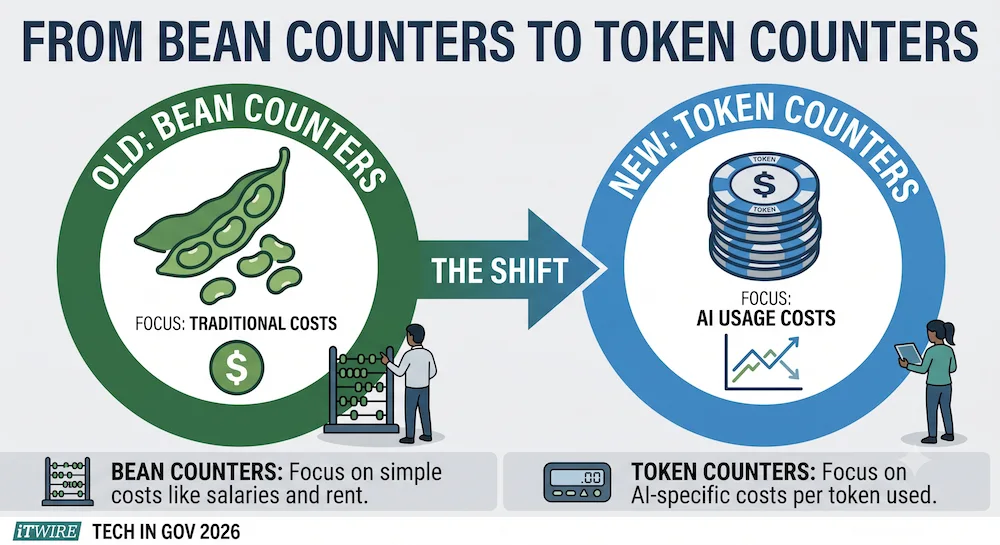
The token counters are taking over from the bean counters
The session that clearly landed with Griffith was about token costs, the per-call price of running large language models. He has skin in this game. On the side he builds retrieval-augmented generation systems, bespoke applications that sit your own data on top of public models, so he has watched the meter run in real time.
His advice to anyone wiring up an agent is to use ordinary automation wherever ordinary automation will do, and to save the model for the parts that genuinely need it.
“You want to use automation, but not AI as much as you can, to save the cost of the calls to AI, because you can save a client thousands and thousands of dollars a month,” Griffith said. His worked example is stark: a badly built agent that reaches for the model at every step versus a well-built one that only calls it when it must. “It could be the difference between an agent costing $100,000 dollars a month and $10,000 dollars a month, if you do it correctly.”
The second lever is picking the right size model for the job. A customer-service chatbot or a basic financial calculation does not need the same frontier model as a research scientist working on quantum physics, and the newest models cost the most per token.
“You don’t need some agents to have the most state-of-the-art versions of AI, because the token cost is much, much more expensive. It’s horses for courses,” he said.
His line of the day, and the one I suspect gets quoted back at future conferences: “Instead of bean counters in government, we’re going to see token counters becoming the new discussion point in the public service.”
I have heard versions of this everywhere lately. There is the widely repeated (and never officially confirmed) story of a company that reportedly burned through half a billion dollars in token costs in a single month, and plenty of firms quietly admitting the models now cost them more than the people did. The whole promise was supposed to be savings. The bill says otherwise.
There is a familiar pattern underneath it. Griffith calls it the oldest trick in tech: “They lure you into a situation of dependency by making it free, very cheap. And then when you’re hooked, the price goes up.” He sees it as a developer too, where a platform that costs nothing at low volume quietly turns into hundreds of dollars a month once you lean on it.
Cost, more than capability, is now the tempering factor on AI. It is also why the efficiency race matters. Model makers including Anthropic have made token efficiency, getting more work done per token, a headline feature of their newest releases rather than a footnote, and you can see why in the pricing. Everyone gets that AI is powerful. If it bankrupts the department running it, that power is academic.
Data sovereignty and sovereign risk have been conference staples for a couple of years. Griffith’s sense is that government has actually improved here, and is taking it more seriously at a policy level.
The open question is enforcement. The government has moved on AI rules, including proposed mandatory guardrails for high-risk uses and a new Office of AI to coordinate the response. Griffith’s worry is what happens when that framework meets the biggest technology companies on earth.
“Are we going to get any better enforcement with AI than we have with tax?” he asked. His analogy is deliberate. Australia has struggled for years to close the tax workarounds that large multinationals engineer, and he expects the same cat-and-mouse dynamic to play out with AI.
“We’re going to struggle with our great new regulatory standards framework that the Prime Minister, Anthony Albanese, talked about,” he said. I noted that “Governments set up rules and regulations, and companies find their way around it.” Nobody at the conference seemed to disagree, which is its own kind of answer.
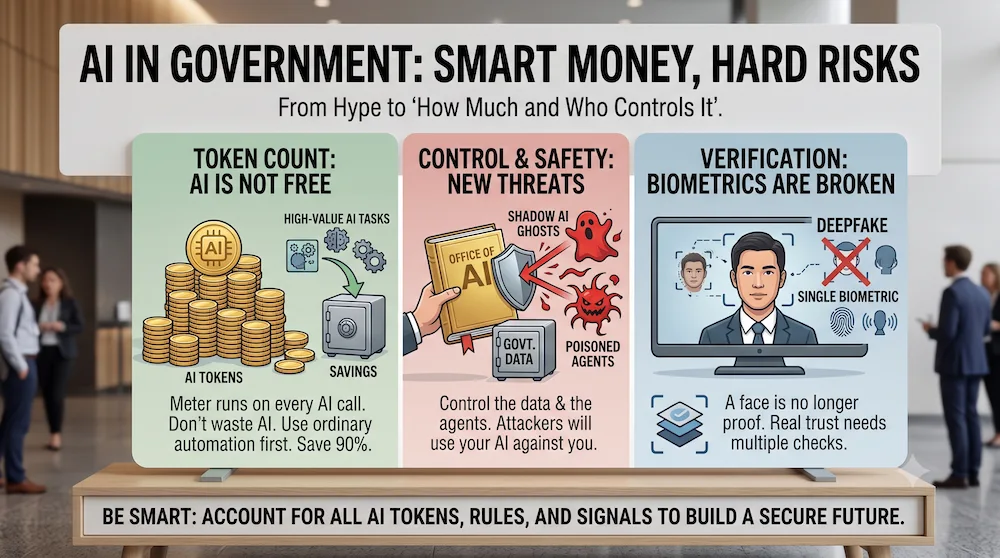
Cybersecurity in a dark room
If AI cost was the fresh anxiety, cybersecurity was the evergreen one. Griffith’s framing has a chill to it, because the threat has stopped being something defenders can fully picture.
Put AI in the hands of scammers who understand it, add the quantum computing that is coming, and you get intrusions that defenders may not even be able to imagine, let alone stop.
“You’re walking around in a dark room without being able to see the walls,” he said.
He watched representatives from the Department of the Prime Minister and Cabinet and Parliamentary Services describe getting ready for attacks at that level, including running simulations to predict what might come. His takeaway was that nobody has a clean solution yet.
That includes the vendors. Griffith singled out a presentation from HP on a threat that keeps security people up at night: not just the poisoning of data, but the poisoning of AI agents themselves. If an attacker can reach the instruction set you give an agent and quietly rewrite it, they can turn your own automation against your data. It is the kind of risk catalogued in the OWASP Top 10 for large language model applications, and it is no longer theoretical.
“We can actually turn AI agents around and make them absolute enemies of the companies that employ them,” Griffith said. His conclusion, which I concurred with, is that the defence is more AI, not less: “We’re going to need AI agents that are good and on our side and unhacked, to protect us from the ones that are malicious.
The moment from the conference floor that clearly rattled Griffith came from the CSIRO. He relayed a warning from a CSIRO speaker that cuts against a decade of identity design (I could not pin down which CSIRO presenter said it, and I would welcome the correction if anyone at the session can name them).
The line, as Griffith recalled it: “A biometric signal is no longer independent proof of identity.”
Sit with that for a second, because we have built a lot on the opposite assumption. Face, fingerprint, voice: we treat each as its own proof. The message from CSIRO, he said, is that the only reliable path now is a multi-layered approach, several signals combined, because any single one can be faked. It echoes what identity researchers globally have started saying out loud, that no single biometric wins trust on its own anymore.
Two-factor authentication was step 1. Griffith’s point is that real multi-factor, multi-signal identity is now the baseline.
Detection is getting harder in parallel. He noted the same CSIRO framing on video: it is becoming much harder to be sure a clip is not a deepfake. Layer that on top of an internet that many people already treat as their source of truth, and the confusion compounds.
He tied it to a media story close to home. With the news media bargaining arrangements being reworked (the government has floated a levy on Meta, Google and TikTok to fund journalism), Griffith worries about what happens if trusted news weakens while social platforms fill the gap with synthetic content.
“We see how much AI slop is out there, and with a little bit of tweaking, that can be much less slop and much more convincing fakery,” he said. “It’s a pivotal time for us to get this right.”
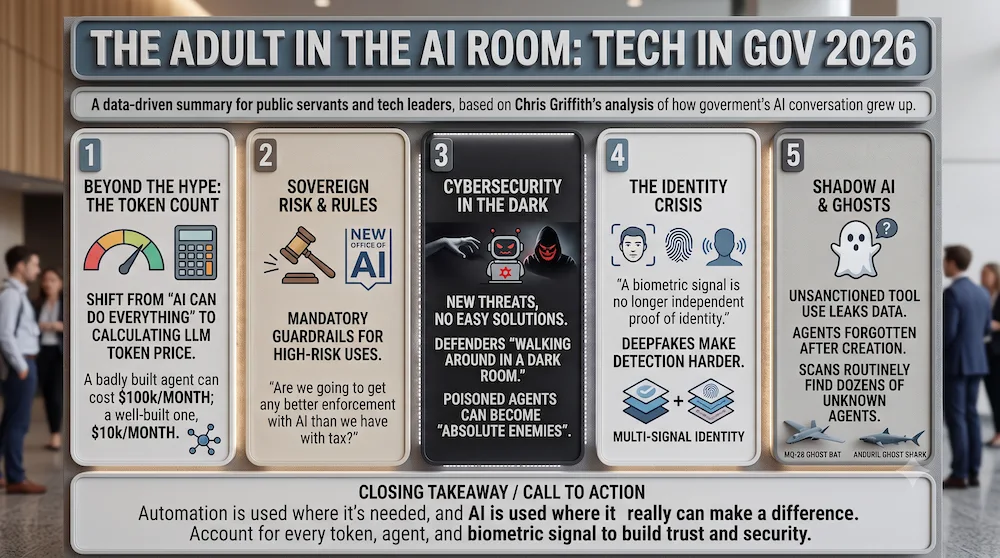
Shadow AI, and the agent nobody remembers switching on
On the defensive side, there was a note of cooperation. Griffith pointed to the National Cyber Security Coordinator, Lieutenant General Michelle McGuinness, who described a rising level of cooperation across the tiers of government and new partnerships aimed at a unified response to threats against infrastructure and defence.
Then there is the threat from inside, which Griffith summed up in two words: shadow AI. In the public service, plenty of AI use is sanctioned. The danger is the staffer who reaches for an unsanctioned tool without realising that the act itself can leak information out of a department, or open a door for someone to get in.
The part that should worry any CISO is the time lag. “The problem is that you may not know for a long time that it’s occurred,” he said. Worse, an agent can be stood up, do its job, and then simply keep running after everyone has forgotten it exists.
“After some time there is no realisation that the agent is still operating there, and who knows what could be happening with it,” Griffith said.
This is exactly the discovery problem the identity industry has been circling, and the vendors are now hunting for it. Griffith described tools that scan an organisation for every AI agent present and routinely turn up dozens that were never sanctioned, which then get shut down. It maps onto the pitch I have heard from identity players like Okta, and onto a wave of shadow-AI discovery features landing across the governance market.
His logic is hard to argue with: “They can’t shut it down if they don’t even know it’s there, and they don’t know what it’s up to.”
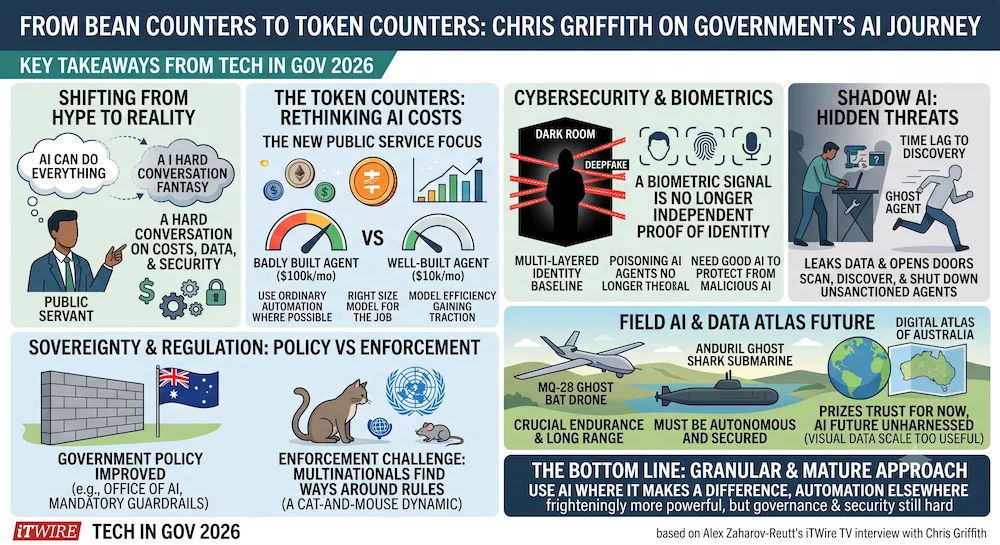
Ghost Bat, Ghost Shark and a stockpile of drones
Defence brought the conversation somewhere more physical. The Department of Defence talked up further AI in the field, and Griffith zeroed in on two Australian programs with excellent names.
The Boeing MQ-28 Ghost Bat is the pricey one, an autonomous “loyal wingman” drone that can range across the country on surveillance runs and is heading toward combat service later this decade. The Anduril Ghost Shark is the quieter one, an extra-large autonomous submarine that can stay under for weeks, with the first units already delivered to the Royal Australian Navy and a manufacturing line up in Sydney.
For a country Australia’s size, Griffith argues, the endurance is the whole point. We need long range and long time-on-station more than most nations do, in the air and under the water both.
The lesson he keeps returning to comes from Ukraine, where cheap autonomous systems have rewritten naval and air warfare, from the Magura sea drones that pushed Russia’s Black Sea Fleet back to the deep strikes on Russian bombers. “Ukraine has shown us how important drones are,” I noted.
His caveat is the security one, and it connects straight back to the cyber conversation. A drone fleet is only an asset if it stays yours. “We need them autonomous, and we need them secured. They can’t be taken over by a nation state and turned against us.”
Griffith’s last stop was the quiet engine room of government data. He spent time with the team behind the Digital Atlas of Australia, the Geoscience Australia platform that pulls trusted national datasets onto a single interactive map and checks that government information, mapping and Australian Bureau of Statistics data included, is fit to be used.
It is timely work, because the 2026 Census lands on 11 August, a week after we spoke. Griffith has his envelope already.
He asked the obvious question: are they using AI on all this? The answer, for now, is not yet.
“We’re looking at it, but we haven’t taken that big step yet to actually implement it,” he was told. I made the observation that the ABS has managed the census results for 100 years without it, and is in no rush to graft it on before it is ready.
Griffith thinks that will change, and soon. Once you add satellite imagery and mapping to the mix, the ability of AI to read visual data at scale becomes too useful to leave on the shelf.
“AI can slice and dice even more quickly than traditional methods,” I added as you’ll see in the video interview, noting “we really can harness this granular data in ways that were just not humanly possible before, without taking way too much time.” The holdup now is about comfort and trust; the capability is already there.
The bottom line
What struck me most, listening to Griffith at the end of day 1, was how unglamorous the smart version of this has become.
The attitude has shifted hard from 2 years ago, when we all started talking about agentic AI as though it would run everything by itself. The 2026 conversation is granular: work out where in a workflow AI genuinely earns its keep, use plain automation for the rest because it is cheaper and more reliable, and treat every token, every agent and every biometric as something you have to account for.
“Automation is used where it’s needed, and AI is used where it really can make a difference,” Griffith said. That is a more mature idea than “AI, do it,” and a much cheaper one.
He is more confident than he was, though not relaxed. Governance is still the hard part, enforcement still an open question, and the security clock is still running against defenders. And the models keep getting stronger.
“It’s going to be frighteningly more powerful as we go along,” he said, half-smiling. “Maybe the science fiction films will come true.”
This article is based on Alex Zaharov-Reutt’s iTWire TV interview with Chris Griffith at Tech in Gov 2026, held at the National Convention Centre, Canberra, on 4 August 2026. Griffith is a former senior technology writer at The Australian, an iTWire contributor, and the publisher of chrisgriffith.com. Some quotes have been lightly trimmed for length and clarity.
Originally published in iTWire, Aug 5, 2026. AI graphics courtesy of iTWire.